Moon Society/Lunar Development World Map

Courtesy of James Rogers of Lunarpedia


View Larger Map
Showing posts with label Asian Space Race. Show all posts

13 June 2009

The End of Kayuga (Part 2)


Japan's Lunar Probe Kayuga officially ended its mission to our Moon at 1825 GMT.


Launched 14 Sept 2007, Kayuga was a 17 month long exploration of the Moon's surface. Officially named SELENE (SELenological and ENgineering Explorer), Kayuga is the name it was given by the Japanese public. It consisted of a main orbiter flying at 100 km altitude and two small polar satellites - Rstar and Vstar.


Rstar was a small two way relay satellite used to facilitate communications between Kayuga and controllers back at JAXA
. Rstar was also used to measure Doppler shift in the expected orbits of Vstar and the main orbiter. Rstar crashed into the farside on 12 Feb 2009.

Vstar was the other mini satellite used to measure the lunar gravity field. Also known as the VRAD and VLBI (Very Long Baseline Interferometry).


Kayuga has a plethora of instrumentation:
- X-Ray & Gamma Ray Spectrometer for determining the composition of the surface and abundance of certain elements.
- Multi band Imager & Spectral Profiler for the for determining the mineral composition and distribution of the surface.
- Terrain Camera, Lunar Radar Sounder and Laser Altimeter for surface and sub-surface imaging. The Terrain Camera was used to show that there is no surface ice in the permanently shadowed craters of the lunar south pole.
- Several instruments for measuring the Moon's magnetic field and tenuous atmosphere
- The Rstar and Vstar were used to measure the gravitational field of the Moon by measuring the Doppler shift of the Main Orbiter and comparing it to its expected orbit. Vstar was used on the far side where the Doppler shift method did not work.
- The High Definition TV camera was used to take the first HD images of the surface and pretty famous HD video of the Earth rising over the limb of the Moon.


With demise of Kayuga, lunar scientists and enthusiasts turn their focus to NASA's Lunar Reconnaissance Orbiter (LRO) and the Lunar Crater Observation and Sensing Satellite (LCROSS)


Stumble Upon Toolbar


Read more...

10 June 2009

The End of Kayuga


Japan's Lunar Probe Kayuga (Selene) is set to execute the final part of it's mission:

Crashing into the surface of the Moon. Kayuga's orbit is decaying and set to intersect the lunar surface. The crash should take place at a speed of about 6000 km/hr on today 10 June around 1830 UMT (2:30 PM EST). If the Moon is visible at that time (East Asia & Australia), keep your eyes pointed towards the southeastern limb of the Moon. If the 2600 kg probe's crash and resultant explosion are going to be visible, that's where it will be.


Stumble Upon Toolbar


Read more...

11 November 2008

On Orbit XI

The newest Carnival of Space is out.


India's space agency - ISRO, recently successfully launched their first lunar probe, Chandrayaan-1. Chandrayaan-1 reached lunar orbit this past Saturday, 8 November. According to ISRO Director S. Satish, Chandrayaan-1 fired its motors for orbital insertion at 1145 GMT for 805 seconds to enter lunar orbit. India is looking not to miss the boat on this newest space race that China and Japan have begun. National prestige is not the only thing at stake. India is also looking to join the commercial launch industry. India and China are not the only new players in the new space race. The Ukraine and Indonesia have signed a cooperation agreement and Brazil is developing its own launcher the VLS-1.

As of 9 November 2008, the ISRO began circularizing Chandrayaan-1's orbit around the Moon.


Top Blogs


Read more...

24 October 2008

Selene Holds onto Her Secrets


Japanese lunar probe Kayuga (Selene) has tempered hope for large ice fields in the permanently shadowed crater floor of the Moon's polar regions as reported by New Scientist.

Shackelton Crater, one of NASA's targets for a future lunar outpost, was imaged by Kayuga using a camera specifically designed for low light uses.  The floor of Shackelton Crater is in permanent shadow, making it impossible to photograph using normal techniques.  Kayuga's Terrain Camera, a special stereographic imager, used scattered light to capture the floor of Shackleton Crater.  During a short time frame in the lunar summer, sunlight scatters off of the rim of the crater and allowed Kayuga to directly image the floor of Shackleton.  The results were telling in what was not found, rather than what was found.

The absence of clean water ice in the images is sure to discourage advocates of a return to the Moon.  However, all the findings indicate is that there is no frozen lake of ice at the bottom of Shakleton.  Ice may be buried under the regolith or even mixed into the hard, glassy lunar soil.  Another possibility is that the hydrogen that Lunar Prospector detected is from another source.  Frozen methane would be a boon to the outpost, giving astronauts access to both hydrogen a carbon which are both exceedingly rare on the Moon.


Read more...

22 October 2008

Chandrayaan-1 Lift-off!!!


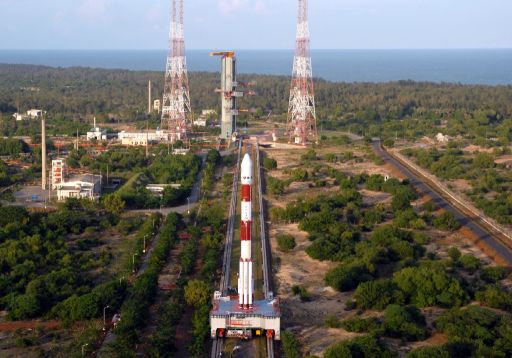
In what is being touted as the 'Asian Space Race' ISRO's Chandrayaan-1 lifted off without a hitch for a two (2) year jaunt around the Moon.  Launching at 0052 GMT into an overcast sky, Chandrayaan-1 reached its orbit in nineteen (19) minutes.  It will be taking the leisurely route to lunar orbit and is expected to arrive in fifteen (15) days.  Chandrayaan-1 is primarily a mapping mission, with instruments from several nations aboard, including two from NASA.  The Moon Mineralogy Mapper will assess mineral resources, and the Miniature Synthetic Aperture Radar, or Mini-SAR, will map the polar regions and look for ice deposits.  This launch comes on the heels of rival China's first spacewalk.  Also in the Asian space race are Japan and South Korea.  China, Japan, India, Russia and the US are the only countries with active plans for a manned lunar landing.

Mini-SAR is particularly important for NASA's future plans.  NASA has announced that it plans to place America's first lunar outpost near the poles to take advantage of two rare resources in the Moon - ice and constant sunlight.  The Moon has a minimal atmosphere and any volatiles, water included, boil off into space.  At the poles, deep crater floor never receive any sunlight and because of that, the temperatures have remained at cryogenic temperatures, allowing ice to remain in the shadows.  As a direct consequence of having crater floors, in permanent shadow, there are peaks of eternal light at the poles.  These mountains have a constant view of the sun, allowing them to bypass the bi-weekly day-night cycle of the moon and use constant solar power.  Constant solar power is not a viable option for outposts anywhere else on the Moon because during the two (2) week long night, outposts would have to switch to battery power stored during the day or some other form of power like nuclear.  Or even lunar thorium powered reactors.  

Also getting into the satellite launching business is Brazil, with their own domestic launcher, the VLS-1, developed by the Brazilian Space Agency and Air Force with Russian help.


Read more...