From this:
To:


Read more...

Live Feed
Currently holding at T-4 minutes. Target launch time of 11:04 EST
The full post goes here
To the Neil Armstrong, Buzz Aldrin and Michael Collins Museum will this issue be laid to rest.
Despite all the evidence that anyone with an inkling of technical training can review and accept, there is still a significant section of the population that believes that Mankind's greatest technical achievement was a hoax. A hoax perpetrated by NASA's Cold War political masters in the Arizona desert solely for the sake of beating the Soviets to Moon. With this belief goes the refusal to face the fact that if the Soviets had been able to expose the secret, they would have in a heartbeat. The fact that they didn't says it all.
There are like minded groups out there - Clavius.org being the most comprehensive, along with the Mythbusters, one of the greatest programs on TV, that can and have done a much better job than I can debunking the nay-sayers conspiracy theories, but I'm still going to do my part. For a more complete list of evidence of the Apollo landings, you can see them here.
The Japanese lunar probe Kayuga imaged the Apollo 15 landing site with its Terrain Camera, a stereographic camera. Here is the original image taken from the ground:
And the reconstruction from Kayuga's Terrain camera. Note that the Terrain Camera has a resolution of 10 meters, so there will be some subtle differences.
These images come to us courtesy of the LRO, in orbit as we speak. To those of you with smaller monitors, I apologize for the size of the images, but it is necessary.
For purposes of scale, this is the Eagle:
Apollo 11:
Apollo 14:
Apollo 15:
Apollo 16:
Apollo 17:
And we thank those who gave their lives chasing a dream for all mankind -
-"It isn't that we don't trust you, Joe [Shea], but this time we've decided to go over your head."
LAUNCH COMPLEX 34, Friday, 27 January 1967, 1831 Hours. Dedicated to the living memory of the crew of the Apollo 1: USAF. Lt. Colonel Virgil I. Grissom, USAF. Lt. Colonel Edward H. White, II, U.S.N. Lt. Commander Roger B. Chaffee. They gave their lives in service to their country in the ongoing exploration of humankind's final frontier. Remember them not for how they died but for those ideals for which they lived.
Courtesy of the Space Fellowship:
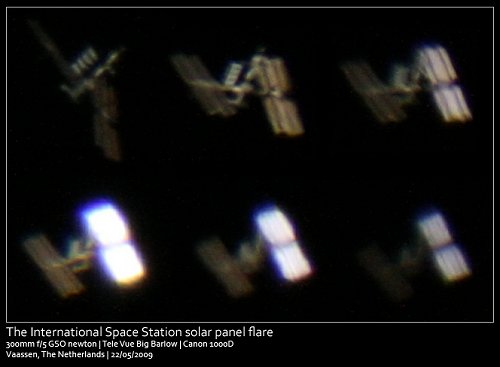
The International Space Station (ISS) is about to make a remarkable series of flybys over the United States. Beginning this 4th of July weekend, the station will appear once, twice, and sometimes three times a day for many days in a row. No matter where you live, you should have at least a few opportunities to see the biggest spaceship ever built.
NASA's ISS Tracker
Especially worrying since everyone else is stepping up in the manned spaceflight department - China even has a Mars probe in the pipeline for later this year.
From Space.com:
Move called a ‘time-out’ as White House awaits review of post-shuttle plans.
WASHINGTON - In a move that reflects the uncertainty surrounding NASA's current strategy for replacing the space shuttle and returning astronauts to the moon by 2020, House appropriators slashed by 16 percent the space agency's $4 billion request for manned space exploration in 2010.
The proposed legislation, marked up June 4 by the House Appropriations commerce, justice, science subcommittee, trims $483 million overall from U.S. President Barack Obama's $18.7 billion budget request for NASA next year. The $670 million cut to the 2010 manned exploration request would leave $3.21 billion, which is less than is available for the effort this year.
Rep. Alan Mollohan (D-W.Va.), the subcommittee's chairman, described the move as a "time-out" in the budget process as the White House awaits the findings of a 10-member panel tasked by the White House to reassess NASA's post-shuttle exploration plans. That panel, led by former Lockheed Martin chief Norm Augustine, is expected to report back with its findings in August.
In his opening statement at the markup hearing, Mollohan said the cut should not be viewed as a diminution of the subcommittee's support for NASA's human spaceflight activities. "Rather, it's a deferral taken without prejudice; it is a pause, a time-out, to allow the president to establish his vision for human space exploration and to commit to realistic future funding levels to realize this vision."
Mollohan told Space News June 4 he is "open to responding to an amended budget request" based on Augustine's review. Mollohan also said he expects the Obama administration to deliver to Congress a "realistic and sustainable" cost assessment of NASA's human spaceflight program in time to amend the 2010 request.
"We invite this report and the administration's response to it, whatever it is," Mollohan said. "We want very much for the funding to be an honest and realistic cost assessment."
Concerns raised
NASA's current human spaceflight plan calls for retiring the space shuttle in 2010 and replacing it with a crew capsule dubbed Orion that would be launched atop a shuttle-derived rocket, the Ares-1, starting in 2015. At the president's request, Augustine's panel is taking a second look at this plan, along with NASA's strategy for returning astronauts to the Moon by 2020, given the likely available budgets over the next several years.
During the hearing, key Republicans expressed concern that the bill would hold NASA's funding next year to 2009 levels. In a June 4 statement Rep. Robert Aderholt (R-Ala.), said he was joining colleagues "in expressing my strong support for increasing this funding as we continue the Fiscal Year 2010 bill process."
Aderholt specifically named fellow Republican Reps. Jerry Lewis of California, the ranking member of the Appropriations Committee; Frank Wolf of Virginia, the ranking member of the commerce, justice, science subcommittee; and John Culberson of Texas.
Other recommendations contained in the bill include a $77million reduction in NASA's proposed space operations budget, which includes the space shuttle and international space station; a $6 million reduction in science; and a $332 million shift in funds from the Cross Agency Support account to a new budget line-item included in the subcommittee's mark. Dubbed Construction and Environmental Compliance, the new account would be funded at $441 million. Congressional aides said the new line item and accompanying funds are aimed at consolidating NASA's various construction efforts into a single pot of money.
Following the markup, the subcommittee posted on its Web site an exhaustive list of earmarks sought by its members. According to the document, money tapped for NASA earmarks totaled close to $15 million.
While increasing NASA's topline funding figure over 2009, Obama's 2010 funding request included an out-year budget profile for the space agency that is some $3 billion lower than was anticipated at this time last year.
Paul Shawcross, chief of the science and space branch in the White House Office of Management and Budget, said the administration's commitment to NASA was evident in the 2009 stimulus package — which included $1 billion for NASA programs — as well as in its 2010 budget request.
"But after 2010, it's flat to 2013," Shawcross said June 2 during a symposium hosted by the George Washington University here. He attributed the flat funding profile to the recession and anticipated recovery measures. He said the Obama administration is facing a $1.26 trillion deficit in 2010, a figure the president hopes to reduce to about $500 billion by 2014. Consequently, funding for NASA and other discretionary spending will be squeezed in the out-years.
"That fiscal environment is reflected in NASA's topline request," Shawcross said.
Meanwhile, W. Michael Hawes, associate NASA administrator for program analysis and evaluation — who is charged with leading the agency team that will provide technical and analytic support to the Augustine panel — said the blue-ribbon commission's work is under way.
"We're starting to get questions from the panel, and we'll be doing a series of fact-finding telecons, site visits, public meetings," he told the symposium audience. Hawes said one area on which the panel will focus is the role international cooperation plays in U.S. manned spaceflight. He said the panel would hear from four international space station partners as part of the review process.
Damon Wells, senior policy analyst in the White House Office of Science and Technology Policy, said pursuing international relationships is a key aspect of space policy. "The panel has been explicitly asked to look at international cooperation," Wells told the audience. "It is part of the dialogue."
Hawes told Space News June 2 that the panel would not have time to produce an interim report, though the committee expects to brief the White House on its findings mid-August. The committee's final report is expected at the end of that month. The Augustine panel's first public meeting is slated for June 17.
Other speakers at the symposium questioned whether the Augustine panel has been granted sufficient time to do its work.
Marcia Smith, president of the Space and Technology Policy Group, a consultancy here, said the Augustine panel would provide little more than a snapshot in time given its deadline.
"Not everyone agrees on the mandated timing," she said. "Congress, in particular, wants it not to be constrained."
Jeffery Bingham, a member of the Senate Commerce, Science and Transportation Committee's Republican staff and senior adviser on space and aeronautics, agreed.
"I am worried about the time they have, and the resources they have," he told the audience. "It's going to be dicey."
Bingham expressed concern that Augustine was told to limit the options his panel is to present to the administration.
"We think it prejudges the outcome," he said. "We want to see that it is wide open and that all options are on the table."
Richard Obermann, staff director for the House Science and Technology space and aeronautics subcommittee, said lawmakers are encouraged by the additional funds for NASA programs in the 2009 stimulus package and the 2010 budget request. But Obermann expressed "uncertainty with the new administration's intentions," particularly in the out-years, where NASA's topline funding is flat.
Oberman said increases in other parts of NASA's budget, including aeronautics and Earth science, came at the expense of out-year funding for space exploration. Obermann said he sees NASA's current funding projections for 2010-2014 as a placeholder, and that he expects the Augustine panel's review to influence funding for the space agency's exploration programs in the out-year timeframe. Obermann said he was encouraged by the choice of Augustine to lead the human spaceflight review, noting testimony Augustine gave before the House Science and Technology Committee in 2004, shortly after former President George W. Bush announced plans to replace the space shuttle and return astronauts to the Moon.
At that time Augustine said manned space exploration offered many benefits, but that "it would be a grave mistake to try to pursue a space program on the cheap. To do so is in my opinion an invitation to disaster. There is a tendency in any can-do organization to believe that it can operate with almost any budget that is made available. The fact is that trying to do so is a mistake — particularly when safety is a major consideration."

NASA launches the twin STEREO probes in search of remnants of the collision that produced the Moon.
Some scientists believe that the Moon was created when the Earth was hit by a Mars sized object. Theia was conceieved by Edward Belbruno and Richard Gott if Princeton. The Theia Hypothesis is a subset of the Great Impact Theory of lunar formation. Belbruno and Gott believe that the impactor that hit the Earth 4.5 billion years ago came from one the Earth-Sun Langrangian points. Langrangian points are the five places where the gravitational pull of two bodies cancels each other out.
Most people are familiar with Jupiter's Trojan points and the asteroids that reside there. Earth and the Moon also share Lagrangian points. NASA's STEREO probes are going to the two most stable Lagrangian points belonging the Earth-Sun system, L4 and L5. Part of STEREO's mission is to look for planetoids leftover form the formation of Theia. STEREO is primarily a solar observatory mission, similar to the NASA/ESA stalwart SOHO. SOHO has been in orbit around the Sun-Earth L1 Langrangian point since 1996. The STEREO will be passing through the Sun-Earth L4 and L5 points, which are 60 degrees ahead and behind of Earth in its orbit, and they will continue on their paths past both sides of the Sun.
Though I missed it live on TV, I understand NASA's new lunar rover made an appearance during the parade. Take a look at those tweels. They were tested here.
NASA's Chariot rover was showing off its 360 degree steering ability for the President and VP. As seen here, the Chariot is in its Small Pressurized Rover configuration. The SPR allows the astronauts to explore the lunar surface without having to wear a full spacesuit.
Here is a link to a video of the Chariot in action.
The Chariot consists of the Mobility chassis and the removable SPR cabin unit. Chariot gives astronauts three options for riding. Without the SPR in suits in rotating turrets is probably the option the system got its name from - Chariot. The next option is to ride without suits inside the SPR - car mode. The final option is a combination of both - the SPR is mounted to the chassis, and astronauts ride in a turret - ideal for transporting large, unstable loads.
The suits are intergated into airlocks called suitports the allow quick ingress/egress with a minimum of air waste.
Chariot masses 1000 kg and has a top speed of 10 kph. It can carry a payload of 3000 kg, which matches the weight of the SPR. It's 4.5 m long, 1.3 m high and has a 4 m wheelbase. The SPR gives Chariot a potential range of 240 km, compared to 10 km for Apollo's rover. In addition, the suitport airlock is rated for 72 hours storm shelter protection from a solar particle event, or solar flare. The lock is lined with 2.5 cm of water ice, one of the best natural radiation shields known.
Download Small Pressurized Rover Fact Sheet (3.7 MB PDF)
http://www.nasa.gov/directorates/esmd/home/black_point.html

SpaceX has completed integration of their Falcon 9 vehicle at Space Launch Complex 40 at Cape Canaveral and have raised it to a vertical position in preparation for a demonstration flight. See pictures below.

In this episode of On Orbit we have Space Based Solar Power (SPSP), Great Britain's lunar probe, a status update on the Dawn probe, SpaceX at it again,
In the Space Review, we have the 1st argument for SBSP that I have seen coming from the military side of things. Pakistan can and has closed access to the nearest port, Karachi, to American forces and can do so at any time. Coalition troops fighting in Afghanistan are dependent on over-land convoys from Karachi for supplies. With SBSP, isolated areas like Afghanistan, Diego Garcia and innumerable land locked countries can have independent access to electrical power. There are some detractors though and they bring up good points.
MoonLITE, is the next lunar probe in the the pipeline. The 100 million pound (pound sterling, not pound weight) probe is set to investigate the cause of the mysterious moonquakes.
JPL's Dawn spacecraft shut down its ion propulsion system as scheduled. The spacecraft is now gliding toward a Mars flyby in February of next year. "Dawn has completed the thrusting it needs to use Mars for a gravity assist to help get us to Vesta," said Marc Rayman, Dawn's chief engineer, of NASA's Jet Propulsion Laboratory, Pasadena, Calif. "Dawn will now coast in its orbit around the sun for the next half a year before we again fire up the ion propulsion system to continue our journey to the asteroid belt."
SpaceX is showing off yet again, by completing a full mission-length firing of the Falcon 9's 1st stage. It was a static test and it lasted 178 seconds.
As an added bonus, we have a couple NASA related articles by Alan Stern - NASA's Black Hole Budgets and Imagine Reconnecting NASA.


Lunar Analog Field Demonstrations of In-Situ Resource Utilization & Human Robotic Systems hosted by PISCES, the Pacific International Space Center for Exploration Systems, a joint U.S. - Japan venture based in Hilo, Hawai'i, concluded this week. The tests focused on lunar production of oxygen for life support.
Life support for a four (4) to six (6) person outpost would require about two (2) metric tons of oxygen per year according to NASA. The tests featured several experiments:
There were three (3) rovers:
And four (4) independent experiments
Scarab was the testbed for both the RESOLVE drilling science package and the Michelin Lunar Wheel, developed by Clemson University for Michelin. RESOLVE featured a core sample drill developed by NORCAT (Northern Centre for Advanced Technology), a Canadian Space Agency contractor. The Bucketdrum rover was used to feed simulated regolith into the PILOT plant and Cratos delivered material into the ROxygen plant.
However, these were just the big name projects at the test. The were numerous smaller projects going on - testing of other gear from Canada and Germany took place during the near two-week project.
The main objective for the two week program was to get the experiements working in the field. This allows operation in non-ideal conditions similar to those that we would face on the Moon and allows us to account for them before we land. Hilo was chosen because volcanic soil closely mimics the regolith found on the lunar surface.
ASTRODAY.NET has the largest collection of pictures from the event and even a movie. Make sure you check them out.
Michelin, tire manufacturer and developer of the TWEEL has modified the tweel for use on NASA's lunar rover.
Michelin also provides NASA with the tires for the Space Shuttle. The MICHELIN Lunar Wheel is reportedly 3.3 times more efficient in load capacity than the wheels on the previous lunar rovers. The tweel was specifically designed for low temperature, low rolling resistance applications. It was field tested by Carnegie Mellon University's Scarab Rover. The Scarab was a participant in the Lunar Analog Field Demonstrations of In-Situ Resource Utilization & Human Robotic Systems hosted by PISCES, the Pacific International Space Center for Exploration Systems, a joint U.S. - Japan venture based in Hilo, Hawai'i.
The Michelin Lunar wheel is partially funded by NASA's Innovative Partnership Program.

Beyond the Moon: A New Roadmap for Human Space Exploration. The Planetary Society's new approach to space exploration in the future. And the reason for Harrison H. Schmitt's leaving his post as Chairman of the NASA Advisory Council and the withdrawal of his support for The Planetary Society.
With Beyond the Moon, The Planetary Society has stated these goals:
Most notable is a de-emphasis on returning to the Moon and the emphasis on Mars as the eventual target of the space program. You can download the entire report from the Planetary Society's website as a 2.9 MB pdf.
This is Schmitt's email to the Planetary Society:
From: Harrison H. Schmitt
To: tps@planetary.org
Cc: [multiple members of the media]
Sent: Fri Nov 14 14:18:13 2008
Subject: Resignation from Society
Dear Lou, Jim and Scott
I am sorry, but I can no longer support the society in its goals as they seem to have gone back to being more political than rational. I want humankind on Mars more than most, but I, at least, feel obligated to look at this goal rationally. Specifically, relative to your bullet points:
TPS Statement * focusing on Mars as the driving goal of human spaceflight
---Having been deeply involved in this issue for many years, and having led several objective studies related to it, it is clear to me, and many other knowledgeable people, that returning to the Moon is the fastest and most cost effective path to Mars for the following reasons:
1. We need generations of engineers to relearn how to operate in deep space at and for long durations on a location that is more accessible than a trajectory to Mars or on Mars itself.
2. We have no clear technology approach for landing large payloads (40MT+) on Mars. Developing entry, descent and landing (EDL) concepts and testing those concepts in the Earth's upper atmosphere will be a major program in and of itself with uncertain cost and duration.
3. Knowing whether 1/6th g triggers human re-adaptation from the adverse consequences of 0g is critical to the design and mass of both Mars transportation systems and Mars surface operations.
4. Many concepts that will be required for operations on Mars need testing in a real-world deep space environment before committing to using those concepts in Mars exploration, including autonomous crew operations during entry, decent, landing and real-time exploration without communications support from Earth.
5. We need a heavy lift launch infrastructure that can support the assembly of large interplanetary spacecraft in Earth orbit, and the requirements to return to the Moon support the development of that infrastructure.
6. We need to develop an interplanetary propulsion system that allows continuous acceleration and deceleration so the travel time to Mars can be cut significantly. That also constitutes a program of uncertain duration and cost.
7. Depending on future understanding of several unknowns already mentioned above, access to lunar-derived consumables after leaving Earth-orbit may be necessary to reduce the launch mass of an interplanetary spacecraft to a feasible amount.
8. We need to certify sample collection and protection protocols on the Moon with exposure to lunar dust and polar volatiles as surrogates for micro-organisms or the planetary protection lobby will make sample return from Mars impossible.
9. We need to use robotic drilling and definitive testing on Mars to penetrate what is probably the only potential biogenesis and evolutionary environment on Mars that has been stable for >3.8 billion years, namely, the cryosphere-hydrosphere interface below the surface.
10. Extremely strong scientific reasons for further lunar exploration exist as have been documented by a large fraction of the lunar and planetary research community at the NASA Advisory Council's 2007 Tempe Workshop and by the National Research Council's recent study.
11. Returning to the Moon has a far better chance of sustained political support than does a far, far more costly, start from scratch Mars program.
Absent sustained and increased budgetary support for the Vision for Space Exploration by the incoming Administration and Congress, any deep space initiative will be in doubt.
12. Finally, becoming a deep space-faring nation again constitutes a mult-generational endeavor, particularly if Mars is in the mix. Unfortunately, the government-run, politicized K-12 school system will not currently support such an endeavor. It has totally failed several generations of young people, not just in STEM subjects but in history, language and economics. This problem has to be solve first. The people requirements for a return to the Moon should help jump start that process, although it will take a much more grassroots effort to be successful.
TPS Statement * deferring humans landing on the Moon until the costs of the interplanetary transportation system and shuttle replacement are largely paid
---This strategy would leave deep space activities, exploration and resources to others, i.e., China, India, maybe Russia, for the indefinite future. I believe that would be major step in initiating the decline of America's global influence for freedom and the improvement the human condition. Although I wrote the book "Return to the Moon" as an illustration of how it makes financial and national sense for private investors to provide the Earth with the benefits of lunar helium-3 fusion power, having NASA develop the initial Earth-Moon infrastructure may hasten the time when that alternative to fossil fuels and non-economic other alternatives becomes available.
TPS Statement * accelerating research into global climate change through more comprehensive Earth observations
---As a geologist, I love Earth observations. But, it is ridiculous to tie this objective to a "consensus" that humans are causing global warming in when human experience, geologic data and history, and current cooling can argue otherwise. "Consensus", as many have said, merely represents the absence of definitive science. You know as well as I, the "global warming scare" is being used as a political tool to increase government control over American lives, incomes and decision making. It has no place in the Society's activities.
TPS Statement * achieving a step-by-step approach of new achievements in interplanetary flight, including a human mission to a near-Earth object
---Returning to the Moon achieves "step-by-step approach of new achievements in interplanetary flight" far better than not doing so, as I have indicated in my list above. Not going by way of the Moon will make the Mars objective far more difficult and more costly to achieve.
---Also, returning to the Moon enables a mission to a near-Earth object if such a mission can be justified scientifically, operationally, or resource-wise. I remain a skeptic on all three but am willing to debate the point.
---Returning to the Moon further enables, in a much more timely fashion and would a Mars initiative, the capability to do something about diverting an asteroid on a collision course with the Earth. We had this capability once, but lost it when the Saturn V assembly line was shut down in the early 1970s.
TPS Statement "In short, the Roadmap calls for "A new and flexible program, based on a series of important first-time achievements and an international commitment to exploration and discovery." International cooperation is strongly recommended both to reduce costs for any one nation and to increase public interest and support."
---I see that the Society has gone back to its roots on "international cooperation." If that phrase means "international management" of the critical path items in a Mars Program, then you clearly do not want to go to Mars. Nothing will prevent success with more certainty than to try this. The rest of the world will want a "one-nation, one vote" management regime for which history shows only a record of abject failure.
Many of the Society's members are good friends, but I just cannot support you in this effort.
Best regards, Jack
Draw your conclusions.


 Posts
All Comments
Posts
All Comments