Moon Society/Lunar Development World Map

Courtesy of James Rogers of Lunarpedia


View Larger Map

12 October 2008

NASA Science Mission Directorate Cost Overrun Coverup

Freom Spaceref.com:

Last year, before Ed Weiler came back to NASA Headquarters to be the Associate Administrator for NASA's Science Mission Directorate, an internal cost study was done to see how much SMD overruns every year on its various projects and missions. That study showed $5.4 billion of cost increases over a 4 year period. The goal posts for this study involved measuring costs starting from either the cost contained in the FY 2005 budget or, if the project started later, from its Phase B cost. The costing period then extended forward to the amount that it had increased to for the FY 2009 budget submission. 

This large lump of overruns did not sit well with Ed Weiler, so he decided to order folks to make it go away. How to do it? Simple: just move the goal posts. In so doing, you use Congressional guidance (Nunn-McCurdy) as a smoke screen to hide the true magnitude of cost increases. 

According to sources inside SMD at NASA Headquarters, Weiler's approach was to forget the numbers that NASA and the scientific community originally bought into when missions were agreed to. Instead, Weiler directed that SMD now use the numbers that arose down the road - after a mission had reached Phases C/D - and then to look at cost growth from that point forward to FY 2009 budget. In other words, Weiler decided to pick numbers that were "more mature" as a starting point.  

Of course, this approach resulted in a smaller number since the growth from buy-in to Phase C/D was "forgotten". Weiler also ignored additional costs that were incurred to enhance scientific return and other factors deemed beyond the scope of NASA's responsibility. The new number? Only $1.5 billion in cost increases over 4 years as opposed to the earlier $5.4 billion figure. 

Sounds much better that way, right? Alas, this is simply another example whereby NASA cooked the books to make a bad situation look less bad. 

Of course, in his defense, Weiler will say that he used metrics and thresholds specified by Nunn-McCurdy. Congress may direct NASA to look at numbers and cost growth that way, but this approach simply does not cover the actual cost growth that has occurred from the original number NASA bought into to start with. 

One example is the game being played with real cost of the Mars Science Laboratory. MSL's cost has gone from an inital $650 million (recommended in the Decadal Survey as a "medium cost category" mission) up to the current estimate of over $2 billion. If you use the Nunn-McCurdy goal posts you do not start to track cost increases at the initial $650 million buy-in figure, but rather you start counting at the level that $650 million grew to i.e. $1.4 billion. 

When you move the goal posts to this new point, $750 million in cost growth just disappears. This way, NASA can cite Nunn-Mcurdy and say "it is a 30% increase from $1.4 billion up to $2 billion". NASA can now ignore the cost growth from $650 million up to $1.4 billion as if it never happened. 

But things have been getting so bad on MSL that even this approach cannot completely hide a serious (and growing) cost problem - one that threatens the vitality of NASA's entire planetary exploration program. 

In the end, the process of sweeping these cost increases under the rug means that the taxpayers get cheated out of the full story as to how the cost grew on this mission. The truth is obvious: NASA does not want them to know. 

 Editor's update: in a telecon with reporters today, a telecon that was supposed to discuss “technical and budget issues” on MSL, NASA personnel more or less avoided providing any specific budget news and tried to shift the discussion back to technical issues. 

Ed Weiler stated that his team had a third meeting with NASA Administrator Griffin to discuss MSL. We said that NASA has "made significant technical progress since the May meeting" and "we are heading toward a March 2009 launch". 

When asked to come up with a cost impact for current issues, Weiler said "we do not have exact numbers" and that NASA has "no exact estimate from JPL. We are going our own analysis." When pressed for exact numbers, Weiler said "I am not at liberty to pass out numbers." 

The MSL cost increase was described as being from an estimate of $1.6 billion in August 2006 to an estimated $1.9 billion today. 

When asked if funds will be needed and where they would come form, Weiler said "When we know the final cost in 2009 we'll first look within the Mars program and then outside the program." He noted that there are some cost phasing techniques that can allow resources to be freed up. 

When asked again to described what the final cost for MSL would be, Weiler said that "those numbers are being developed. We'll work with OMB and Capitol Hill. It is clear that funding is needed if we go in 2009." 

When asked to comment on why an initial MSL cost number of $1.6 billion was used as a basis to calculate cost overruns and not the original $650 million buy in figure, Weiler said "the way NASA accounts to Congress - the cost that NASA commits to - is the cost that NASA buys into - is at Phase C. You do not understand the cost of a mission until Phase C and that is what we have to report to Congress and that is What Doug is correctly quoting." 

P.S. If you want to see another example of where NASA constantly changes the cost of a mission, but never admits the true cost, have a look at these posts regarding the Mars Phoenix Mission. Not only did the cost change virtually every time NASA talked about it, they only admitted $100 million that had not been included this year when I pushed the issue. NASA then continued to use an old and inaccurate cost whenever they talked about the mission. Why should anyone believe any cost numbers coming out of NASA?

Why Does The Official Cost of Mars Phoenix Keep Changing?

The Actual Cost of Mars Phoenix is $520 Million


Read more...

10 October 2008

NASA Glenn Releases Results of NIOSH Findings Related to Health Concerns


From The Cleveland Leader:

Due to health concerns at NASA's Glenn's Research Center, the results of a recent inspection by the Ohio Department of Health and the National Institute for Occupational Safety and Health (NIOSH) were released this past Wednesday.

In an interesting twist, one government agency (NIOSH) found that two buildings owned by the other government agency (NASA) did not cause cancer in 65 (!) past and present employees.


Read more...

Carnival of Space #74


Carnival of Space #74 is live!

Next Big Future's post about 20 ton Nuclear plant is my favorite, though this week, I had nothing to contribute.


Read more...

09 October 2008

Newton Shows Lunar Scientists How to Make Telescope


Imagine if you will, a scientific outpost on the far side of the Moon.  No light pollution, no radio interference, nothing to block your magnificent view of the heavens.  You need a telescope and you intend to do some serious imaging, so you want it to be as large as possible.  How do you get it?  You could ship it up from Earth, at a cost of thousands of dollars a pound.  If lunar industry is developed enough, one of the near-side factories could gather up a few tons of regolith, separate the glass out and melt and grind a lens for you.  Or,build your mirror out of a spinning liquid.  On Earth, the largest liquid mirror is the Large Zenith Telescope operated by the University of British Columbia in Canada.  It's 6 meters across, 20% larger than the world famous Palomar reflector in California.  However the Large Zenith Telescope didn't even cost $1 million to construct - only 1/6 of the cost to build Palomar in 1948 dollars.  Today, $1 million is only a few percent of the cost to construct a normal 6 meter telescope.

Another benefit of the liquid mirror is that it's technically simple.  It needs only remain horizontal to local gravity, and to spin smoothly to maintain a smooth reflecting surface.  On the Earth's surface, the edge of a 4 meter telescope spins at 3 miles per hour.  With gravity on the Moon 1/6 that of Earth, the required spin rate would be even lower.  The mirror can only point straight up, so no need for heavy and complicated systems for moving the mirror.  It's aim can be adjusted by using some of the same techniques as the Arecibo radio telescope in Puerto Rico.  If the telescope is place in polar crater that never receives any direct sunlight, you would not need to cool the mirror, which makes it ideal for infra-red astronomy.

From NASA Science News


Read more...

08 October 2008

32,000th Floor Please


American and Japanese scientists say that the manufacturing techniques and materials for building a space elevator should be ready around 2020 or so.  Currently, the stronget material available - carbon nanotubes - have only about a quarter of the strength needed.

Japan, unlike the United States, is prepared to spend $10 billion to develop the technology.  A space elevator would reduce the cost of putting an object in orbit to just the electricity needed to climb the elevator.  Electricity is much cheaper than rocket fuel.


Read more...

07 October 2008

On Orbit V

From Colony Worlds, China draws on its vast manned spaceflight experience and offers to train other countries astronauts.

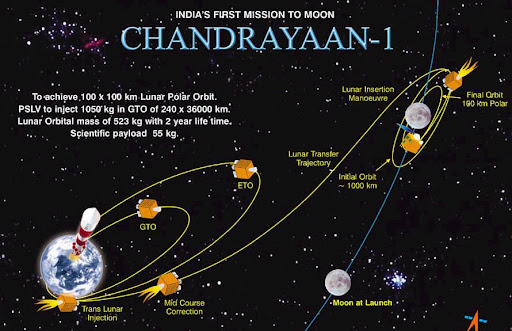
Update: India's Chandrayaan-1 lunar probe is scheduled to liftoff on 22 October with the launch window open until the 26th.

NASA's Cassini probe is scheduled for close flybys of Saturn's moon Enceladus on 9 October and 31 October at a height of 25 km (16 miles!) and 196 km (122 mi) respectively.  Cassini will be sampling Enceladus's many geysers because water vapor and organic compounds have been detected and scientists suspect the existence of underground oceans of water.

China looks forward to its first space station Tiangong 1 to be launched in 2010 or 2011.  Automated flights Shenzhou 8 and 9 will dock with Tiangong 1, a feat made easier given China's demonstrated ability to rendevous spacecraft in space.  The manned flight Shenzhou 10 will bring Tiangong 1's three man crew.  Things are moving quickly in the Middle Kingdom.  Can we keep up?


Read more...

Breaking News!


Edit: Whoops!  A day late.  As a consolation prize,

http://spaceweather.com/submissions/large_image_popup.php?image_name=Eric-Allen-Allen1_1223348248.jpg

Asteroid 2008 TC3 will become meteor 2008 TC3 when it hits the Earth's atmosphere.

However, 2008 TC3 is only a few meter across and will burn up in the atmosphere, creating an impressive fireball.  It's expected to enter the atmosphere at quarter to three in the morning GMT over Sudan.

As an added comfort, 2008 TC3 was only discovered less than 24 hours ago, not even enough time to send up roughnecks with mining equipment and secret space shuttles.


Read more...

02 October 2008

Carnival of Space

Newest Carnival is live.  Checkout what everyone else has to say.


Read more...

01 October 2008

Happy Golden Anniversary NASA

Welcome to our readers from Carnivals of Space.

I want to wish a happy 50th birthday to everyone at NASA.

Born out of the desire to prove American technical superiority, today's NASA has to struggle to prove to necessity of existence.  There are those that believe the paltry amount spent on NASA would be better used building smart bombs or funding the federal education bureaucracy.

Currently, NASA is struggling to maintain an aging shuttle fleet, provide American access to the ISS and develop the next-gen launch system Constellation.  The specter of being dependent on long time rival Russia for access to the ISS looms large with the presidential mandate to retire the Shuttle fleet in 2010.  NASA has a rough road ahead but with the right leadership, budget and motivation (Russian and Chinese lunar outposts), NASA can regain its past position of pre-emininence.

Per Aspera, Ad Adstra


Read more...

On Orbit IV

NASA admin Michael Griffin states that given a choice, NASA would always buy launch services to the ISS from a private company.  Here's your chance SpaceX.  Griffin also affirms that "human populations must diversify if it wishes to survive."  

The Space Foundation has published "ITAR and the U.S. Space Industry." The report proposes steps to modernize ITAR, enabling the regulations to accomplish their original purpose of protecting important security technologies while allowing more U.S. space companies to compete successfully in the global economy.  Interesting because John Goff over at Selenian Boondocks posted about the problems domestic space companies have with ITAR.

Mahmoud Ahmadinejad, President of Iran has stated that Iran will be launching a domestic rocket capable of putting 700 kg into orbit.  The satellite Omid (Hope) will be used for natural disaster management and telecommunications.

NASA to announce new student contest to design tools an instruments to be used on the moon.


Read more...