Courtesy of Tomorrow is Here, we have the newest Carnival of Space!
Read more...

A new type of solar cell that doesn't use silicon in their construction has been developed. According to New Scientist, the new design is dye based and sprayed onto a substrate of titanium dioxide. Titanium dioxide (TiO2) is found on the lunar surface. It is concentrated in the maria. Aside from free samples of TiO2 in the maria, it is locked up in ilmenite - TiO3. This is significant because ilmenite is a major source of lunar oxygen. Hydrogen reduction of ilmenite is one of the simplest processes for in-situ production of oxygen for fuel and life support.
FeTiO3+H2 ---->Fe+TiO2+H2O
The reduction produces free iron, titanium dioxide and water. The water can be cracked into its constituents through electrolysis.
The dye is used to coat TiO2 grains, which sit in an electrolyte in the solar cells. The whole mixture is sandwiched between two electrodes; a transparent glass sheet doped with tin oxide to make it conducting and an opaque rear panel. This allows a current to flow when the cell is placed in sunlight
But the efficiency of dye-sensitised solar cells designed for outdoor conditions is currently about 6%. That's light years from the 42.8% efficiency reached by some silicon solar cells and well below the 15% standard for many silicon designs.
Michael Grätzel of the Swiss Federal Institute of Technology in Lausanne, Switzerland – who co-invented dye sensitised solar cells in 1991 – had thought it may be possible to double the efficiency of his low-cost cells simply by designing one that collects light from both sides simultaneously.
Now Grätzel's team, working with Seigo Ito of the University of Hyogo, Japan, has done just that. Their new dye-sensitised solar cell is almost as efficient at converting light into energy when it strikes the rear side as when it strikes the front.
To achieve the trick, Grätzel's team first replaced the opaque back panel with a second sheet of glass, making the entire device transparent.
The new panel is also coated with tin oxide and acts as the second electrode, donating electrons back to the electrolyte to complete the circuit. But because it is transparent, it lets light into the system from the rear.
Robert Hertzberg, chairman and co-founder of G24 Innovations, a company based in Cardiff in the UK that manufactures dye-sensitised solar products. "This technology allows you to capture power in low light, even rainy conditions," he says. "Silicon cells only allow you to capture power during a short window [when light is intense]." That means the cells give a better performance over the whole day even if they are less efficient under ideal conditions.
Armadillo Aerospace has won the Level One portion of the Northrop Grumman Lunar Lander Challenge! The flew at Las Cruces International Airport on October 25, 2008, and earned the $350,000 in prize money. While they made an attempt to win Level Two on the 26, they weren't able to pull off a double victory, leaving $1.65 million worth of prize money on the table. Check out some highlights from the first day of competition.
Seven seconds prevented Armadillo Aerospace from winning the second year of competition in the two million dollar Northrop Grumman Lunar Lander Challenge. Over two days, Armadillo Aerospace attempted four times to achieve the two flights necessary to win the $350,000 Level I competition. Officials expected them to compete in both the Level I and Level II competitions this weekend, worth $1,350,000 in total first place prize purses.
“They nearly made it in their second attempt,” said Dr. Peter H. Diamandis, CEO and Chairman of the X PRIZE Foundation. “There were more than 85,000 spectators willing them to succeed, as well as the officials and people working on the other teams. The persistence Armadillo has shown is impressive and deserving of recognition. I want to thank the team for their enthusiastic participation and I hope they will continue their important work!”
Armadillo used the MOD-1 vehicle for all four launch windows in the Level I competition, with each window requiring two successful flights. None of the four prize winning attempts were successful, and having reached the maximum number of attempts for Level I, Armadillo ruled out any attempts for Level II.
Saturday morning’s attempt did not leave the ground due to an igniter problem caused by contamination in the feed lines. Saturday afternoon’s first flight, however, was perfect. The igniter problem reappeared in the return flight and blew a hole in the side of the chamber, preventing it from hovering the required 90 seconds. The landing was aborted with seven seconds left as a safety precaution, disqualifying the flight.
Sunday morning’s first flight was again perfect. The second flight left the ground briefly but was also aborted by the team for safety reasons related to earlier problems.
The team continued to experience problems during the last attempt of Sunday afternoon. The engine exploded on ignition, resulting in a small fire and the flight was aborted. The team followed emergency procedures and fire engines were called in, however no one was hurt.
“This weekend, we’ve had more problems than we’ve had in the last six months. We know what went wrong, but not why,” said Neil Milburn, Vice President, Armadillo Aerospace. “The Cup has given us an opportunity to show what we can do in front of multiple audiences, which we would not have been able to do otherwise. We know we’ll be back again, and we’ll nail it next time.”
Armadillo Aerospace is led by John Carmack, who is widely recognized in the video game industry for the creation of games like Doom and Quake. He started Armadillo in 2000 to compete for the Ansari X PRIZE, which was later won by Scaled Composites and SpaceShipOne. Armadillo made a smooth transition from suborbital flight to lunar landers when the Northrop Grumman Lunar Lander Challenge was announced as one of NASA’s Centennial Challenges. In 2006, Armadillo’s “Pixel” was the only craft to fly at the X PRIZE Cup, and narrowly missed the winning the Northrop Grumman Lunar Lander Challenge due to broken landing gear.
“This was a weekend of outstanding competition,” said Dr. William Gaubatz, Chief Judge of the Northrop Grumman Lunar Lander Challenge. “We believe Armadillo set some records in terms of reusability. We hope they carry on and inspire other teams to shoot for the prize and new records.”
The third annual X PRIZE Cup was held at Holloman Air Force Base on October 27 and 28, 2007. It was the first space expo ever in which aircraft and rockets flew at the same event, and is the result of a unique partnership between Holloman Air Force Base, the State of New Mexico and the X PRIZE Foundation. In addition to the Northrop Grumman Lunar Lander Challenge, the 85,000 people in attendance were able to see a state of the art air show with F-117s, F-22s, the Wings of Blue Jump team, acres of static aircraft and space displays, and much, much more.
I'd like to issue a correction.
When news of Dr Houssam Toutanji's development of sulfur based concrete was released, I, in my infinite knowledge panned the innovation as too expensive due to low levels of sulfur. I stated that sulfur was found in the regolith at levels of 400-1300 ppm. However Peter Kokh, current president of the Moon Society, corrected me on the Moon Society's Yahoo discussion group. I just want to say thank you to Peter for the correction. He pointed me to this article here, and a little digging of my own led to this and this and if it doesn't take you to the right page, it's page 450. From the paper USES OF LUNAR SULFUR by D. Vaniman, D. Pettit, and G. Heiken: Although sulfur is not so abundant that it is available without effort, it does rank eleventh in weight abundance among the elements in average lunar mare rocks. Gibson and M¢_re ( 1974 ) found that the high-Ti mare basalts, in particular, have high sulfur contents, in the range of 0.16% to 0.27% by weight. These authors also make the important point that lunar basalts actually have more sulfur than terrestrial basalts.
Sulfur is best found in mare basalts, specifically basalts that are high in titanium. Given that NASA is looking at processing ilmenite for oxygen, the same regolith that we'd be processing for oxygen can be use to extract sulfur for construction.
Altair VI, a fellow space blog pointed me in the direction of a treasure trove for lunar enthusiasts.
I present the single paper "Uses of Lunar Sulfur" from the National Space Society's website and the "The Second Conference on Lunar Bases and Space Activities of the 21st Century, volumes 1 and 2" from the Harvard web-servers.

NASA is testing its Small Pressurized Rover in the Arizona desert (large image). At the 11th annual Desert RATS (Research and Technology Studies), two rover configurations were tested.
One configuration leaves the crew members free to get on and off the rover whenever they like, but they must wear spacesuits at all times to protect them from the lunar environment. The second configuration -- called the Small Pressurized Rover, or SPR -- adds a module on top of the rover’s chassis that the crew can sit inside as they drive the vehicle, donning spacesuits whenever they want to get out.

Thought I would help spread the word.
www.thespaceshow.com/newsletterfinal.htm
Programming For The Week Of October 27, 2008 :
~~~~~~~~~~~~~~~~~~~~~~~~~~~~~~~~~~~~~~~~~~
1. Monday, October 27, 2008, 2-3:30 PM PDT: Louise Riofrio joins us regarding her positive pressure spacesuit and cosmology theories (http://riofriospacetime.blogspot.com/). < /b>
2. Tuesday, October 28 2008, 7-8:30 PM PDT: Dr. Gregory Berns returns as our guest to discuss his new book, "iconoclast" and more.
3. Friday, October 31, 2008, 9:30-11:30 AM PDT: Brian Hanley returns to discuss the topic of bioterrorism as we go beyond the subject of space development for this special program.
4. Sunday, November 2, 2008, 12-1:30 PM PDT: We welcome back noted economist, space advocate and SpaceShot founder, Dr. Sam Dinkin.

Japanese lunar probe Kayuga (Selene) has tempered hope for large ice fields in the permanently shadowed crater floor of the Moon's polar regions as reported by New Scientist.
Shackelton Crater, one of NASA's targets for a future lunar outpost, was imaged by Kayuga using a camera specifically designed for low light uses. The floor of Shackelton Crater is in permanent shadow, making it impossible to photograph using normal techniques. Kayuga's Terrain Camera, a special stereographic imager, used scattered light to capture the floor of Shackleton Crater. During a short time frame in the lunar summer, sunlight scatters off of the rim of the crater and allowed Kayuga to directly image the floor of Shackleton. The results were telling in what was not found, rather than what was found.
The absence of clean water ice in the images is sure to discourage advocates of a return to the Moon. However, all the findings indicate is that there is no frozen lake of ice at the bottom of Shakleton. Ice may be buried under the regolith or even mixed into the hard, glassy lunar soil. Another possibility is that the hydrogen that Lunar Prospector detected is from another source. Frozen methane would be a boon to the outpost, giving astronauts access to both hydrogen a carbon which are both exceedingly rare on the Moon.
Russia looking at consolidating aerospace industry assets into state agency. Decision to be made in 2009.
NASA Goddard CIO joins the blogosphere:Goddard CIO Blog
NASA JSC Advanced Planning Office Blog: JSC Advanced Planning Office Blog
Official NASA blogs
SpaceDev to be acquired by the Sierra Nevada Corp: SpaceRef.com
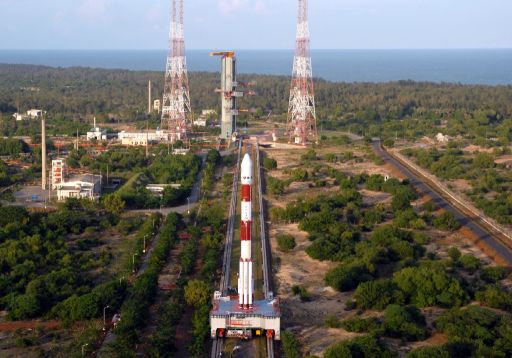
In what is being touted as the 'Asian Space Race' ISRO's Chandrayaan-1 lifted off without a hitch for a two (2) year jaunt around the Moon. Launching at 0052 GMT into an overcast sky, Chandrayaan-1 reached its orbit in nineteen (19) minutes. It will be taking the leisurely route to lunar orbit and is expected to arrive in fifteen (15) days. Chandrayaan-1 is primarily a mapping mission, with instruments from several nations aboard, including two from NASA. The Moon Mineralogy Mapper will assess mineral resources, and the Miniature Synthetic Aperture Radar, or Mini-SAR, will map the polar regions and look for ice deposits. This launch comes on the heels of rival China's first spacewalk. Also in the Asian space race are Japan and South Korea. China, Japan, India, Russia and the US are the only countries with active plans for a manned lunar landing.
Mini-SAR is particularly important for NASA's future plans. NASA has announced that it plans to place America's first lunar outpost near the poles to take advantage of two rare resources in the Moon - ice and constant sunlight. The Moon has a minimal atmosphere and any volatiles, water included, boil off into space. At the poles, deep crater floor never receive any sunlight and because of that, the temperatures have remained at cryogenic temperatures, allowing ice to remain in the shadows. As a direct consequence of having crater floors, in permanent shadow, there are peaks of eternal light at the poles. These mountains have a constant view of the sun, allowing them to bypass the bi-weekly day-night cycle of the moon and use constant solar power. Constant solar power is not a viable option for outposts anywhere else on the Moon because during the two (2) week long night, outposts would have to switch to battery power stored during the day or some other form of power like nuclear. Or even lunar thorium powered reactors.
Also getting into the satellite launching business is Brazil, with their own domestic launcher, the VLS-1, developed by the Brazilian Space Agency and Air Force with Russian help.


 Posts
All Comments
Posts
All Comments


